 Akhet
Akhet
This symbol represents the horizon from which the sun emerged and disappeared. The horizon thus embodied the idea of both sunrise and sunset. It is similar to the two peaks of the
Djew or mountain symbol with solar disk in the center. Both the beginning and the end of each day was guarded by Aker, a double lion god. In the New Kingdom,
Harmakhet (“Horus in the Horizon”) became the god of the rising and setting sun. He was pictured as a falcon, or as a sphinx with the body of a lion. The Great Sphinx of Giza is an example of “Horus in the Horizon”.

Amenta
This symbol represents the Underworld or Land of the Dead. Originally it meant the horizon of the sun set. Later, it became the symbol of the west bank of the Nile, where the sun set and also where the Egyptians traditionally buried their dead.

Ankh
Symbol of eternal life. The gods are often seen holding an ankh to someone’s lips this is considered to be an offering of “The Breath of Life”. The breath you will need in the afterlife.

Atef
The atef crown was worn by
Osiris. It is made up of the white crown of Upper Egypt and the red feathers are representative of Busiris, Osiris’s cult center in the Delta.

Ba
The Ba is what we might call someones personality. It would leave the body at the time of death. During the days the Ba would make itself useful, at night it would return to the tomb. At this time, it would look for the person to which it belonged. This would be the mummy, however, often the egyptians would supply the Ba with a statue in the likeness of the deceased in case the mummy was lost or damaged.
Canopic Jars 
During mummification the internal organs were removed and placed in four containers. These containers often have human or animal-headed stoppers. The word, canopic, comes from the Greek name of the local god of Canopus in the Nile delta, who was represented as a human-headed pot. Canopic jars can be made of limestone, alabaster, wood, pottery, or even cartonnage. The heads of the canopic jar represented the
Four Sons of Horus
From left to right they are;
Imsety: The human headed guardian of the liver

Qebekh-sennuef: The falcon headed guardian of the intestines.

Hapy: The baboon headed guardian of the lungs
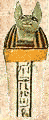
Duamutef: The jackal or wild dog headed guardian of the stomach.
 Deshret
The Red Crown. This was the crown that represented Lower Egypt (northern).

Djed
It is believed that the Djed is a rendering of a human backbone. It represents stability and strength. It was originally associated with the creation god Ptah. Himself being called the “Noble Djed”. As the Osiris cults took hold it became known as the backbone of Osiris . A djed column is often painted on the bottom of coffins, where the backbone of the deceased would lay, this identified the person with the king of the underworld, Osiris. It also acts as a sign of stability for the deceased’ journey into the afterlife.

Djew
Which means mountain, the symbol suggests two peaks with the Nile valley in the middle. The Egyptians believed that there was a cosmic mountain range that held up the heavens. This mountain range had two peaks, the western peak was called Manu, while the eastern peak was called Bakhu. It was on these peaks that heaven rested. Each peak of this mountain chain was guarded by a lion deity, who’s job it was to protect the sun as it rose and set. The mountain was also a symbol of the tomb and the afterlife, probably because most Egyptian tombs were located in the mountainous land bordering the Nile valley. In some texts we find
Anubis, the gaurdian of the tomb being referred to as “He who is upon his mountain.” Sometimes we find
Hathor takeing on the attributes of a deity of the afterlife, at this time she is called
“Mistress of the Necropolis.” She is rendered as the head of a cow protruding from a mountainside.

Feather of Maat
Represents truth, justice, morality and balance. It was pharaoh’s job to uphold Maat. When a pharaoh died, Maat was lost and the world was flung into chaos, only the coronation of a new pharaoh could restore Maat.
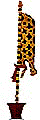
Fetish of Osiris
An animal skin hanging from a stick, this is a symbol of Osiris and Anubis.

Flail and Crook
A symbol of royalty, majesty and dominion.

Heb
The heb glyph represents an alabaster bowl. These bowls were used for special purposes like festivals or feasts.

Heb-Sed
The Heb-Sed glyph Is a combination of the heb glyph and the sed glyph. It represents the Heb-Sed or Jubilee festival. This festival was celebrated on the 30th year of a pharoah’s rule. It was believed to renew the pharaohs strength of rule over the two lands.

Hedjet
The White Crown. This was the crown of Upper Egypt (southern).

Ieb
This symbol represents a heart. The Egyptian believed the heart was the center of all consciousness, even the center of life itself. When someone died it was said that their “heart has departed.” It was the only organ that was not removed from the body during mummification. In the
Book of the dead, it was the heart that was weighed against the
feather of Maat to see if an individual was worthy of joining
Osiris in the afterlife.

 Imenet
These symbols represent the west or western desert AKA the land of the dead. The horizon on which Ra dies at night and enters the underworld.

Ka
The ka is usually translated as “soul” or “spirit” The ka came into existence when an individual was born. It was believed that the ram-headed god Khnum crafted the ka on his potter’s wheel at a persons birth. It was thought that when someone died they “met their ka”. A persons ka would live on after their body had died. Some tombs included model houses as the ka needed a place to live. Offerings of food and drink would be left at the tomb entrance so the ka could eat and drink.

Khepresh
The blue crown was a ceremonial crown often worn in battle.

Khet
This symbol represents a lamp or brazier on a stand from which a flame emerges. Fire was embodied in the sun and in its symbol the
uraeus which spit fire. Fire also plays a part in the Egyptian concept of the underworld. There is one terrifying aspect of the underworld which is similar to the christians concept of hell. Most egyptians would like to avoid this place with its fiery lakes and rivers that are inhabited by fire demons.

Maat
Represents truth, justice, morality and balance. Deities are often seen standing on this symbol, as if standing on a foundation of Maat.

Menat
This symbol represents a heavy beaded necklace with a crescent shaped front and a counter piece at the rear. It was a symbol associated with the goddess
Hathor and her son, Ihy. In fact , Hathor was known as the “Great Menat”. We often see
Hathor using the Menat as a conduit through which she passes her power. It was representative of the ideas of joy, life, potency, fertility, birth, and rebirth. It was not uncommon in the New Kingdom, to see the king offering the Menat to
Hathor. This probably meant to represent the king symbolically with the goddess’ son, Ihy. This idea of divine assimilation was common, although the best examples are of the king representing the falcon god,
Horus.

Menhed
A scribes pallet. Writing was a very important skill to the ancient Egyptians. It was practiced by a group called scribes. The writing equipment used by scribes consisted of a palette, which held black and red pigments, a water jar, and a pen. To be a scribe was a favorable position, even some kings and nobles are show proudly displaying scribe palettes.

Naos
Shrine in which divine statues were kept, especially in temple sanctuaries. A small wooden naos was normally placed inside a monolithic one in
hard stone; the latter are typical of the Late Period, and sometimes elaborately decorated. Also used as a term for temple sanctuary.

Nebu
This symbol represents gold which was considered a divine metal, it was thought to be the flesh of the gods. Its polished surface was related to the brilliance of the sun. Gold was important to the afterlife as it represents aspects of immortality. By the New Kingdom, the royal burial chamber was called the “House of Gold.”

Nebty
The two ladies of upper and lower Egypt. Nekhbet the vulture goddess, protrectress of Upper Egypt and Wadjet the cobra goddess associated with lower Egypt and the Nile delta. There is a beautiful rendering of these two ladies in the White Chapel of Senwosret I.
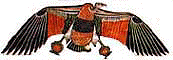
Nekhbet
A goddess portrayed as a vulture. Protrectress of Upper Egypt.

Nemes
A striped headcloth worn by Pharaohs.

Neter
The Gods or having to do with the gods.

Palm Branch
The Egyptians would put a notch in a palm branch to mark the passing of a year in the life of a pharaoh. It symbolized the measure of time.

Pet
This symbol depicts the sky as a ceiling which drops at the ends, the same way the real sky seems to reach for the horizon. This sign was often used in architectural motifs; the top of walls, and door frames. It symbolizes the heavens.
 Primordial mound
The Egyptians believed that during creation this hill rose out of the sea of chaos to create dry land. The idea of this hill rising had a profound effect on the egyptians, being used as every thing from temple layouts to the possible inspiration behind the pyramids. A.K.A benben stone

Pshent
The Double Crown, the red crown and the white crown put together to represent a unified Egypt. Although Egypt was not always a unified nation it was stronger that way.Therefore unification was desirable. Narmer (Menes), the founder of the First Dynasty around 3100 B.C., was the first man recorded wearing this crown.
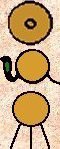
Ra
The sun was the primary element of life in ancient Egypt, we find this importance reflected in the art and religion. Some of the most popular gods had a solar connection. The sun was first worshipped as
Horus, then as
Ra and later as
Amun-Ra There are many other representations of the sun, including
Khepri, the great scarab who symbolizes morning and the ram-headed god
Khnum representing evening. During the reign of
Akhenaten, the sun was worshipped as the
Aten. A form of the sun disk with its rays depicted as arms holding ankh signs. Another common form that the sun takes is that of
Horus Behudety, the
winged sun disk flanked by
uraeus.

Sa
This symbol means protection. Its origins are uncertain, but it is speculated that it represents either a rolled up herdsman’s shelter or a papyrus life-preserver used by ancient egyptian boaters. Either way it is clearly a symbol of protection. From early times the sa plays an important part in jewelry design. It is often used in conjunction with symbols, particularly the ankh, was and djed signs. We often find
Taurt, the hippopotamus goddess of childbirth, resting her paw on a standing sa sign.

Scarab
Called the dung beetle because of its practice of rolling a ball of dung across the ground. The Egyptians observed this behavior and equated it with the ball of the sun being rolled across the sky. They confused this balled food source with the egg sack that the female dung beetle laid and buried in the sand. When the eggs hatched the dung beetles would seem to appear from nowhere, making it a symbol of spontaneous
creation. In this role it was associated with the sunrise.
Khepri was the scarab headed god.
 Sed
Sed
This is a representation of the pavilion used in the Heb-Sed ceremonies.

Sekhem
This is a symbol of authority.

Sema
This is a rendering of the lungs attached to the windpipe. As a hieroglyph this symbol represents the unification of Upper and Lower Egypt. Other symbols are often added to further illustrate unification. There are many fine examples of this symbol throughout Egypt.
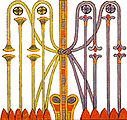
In these renderings we see the Sema bound with two plants, the papyrus and the lotus. The papyrus represents Lower Egypt and the lotus represents Upper Egypt.
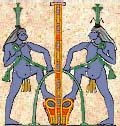
In other representations we find two gods binding the Sema together using lotus and papyrus which represents the binding together of upper and lower Egypt.

Sesen
A Lotus Flower. This is a symbol of the sun, of creation and rebirth. Because at night the flower closes and sinks underwater, at dawn it rises and opens again. According to one creation myth it was a giant lotus which first rose out of the watery chaos at the beginning of time. From this giant lotus the sun itself rose on the first day. A symbol of Upper Egypt

She
A pool of water. The Egyptians portrayed bodies of water by means of equally spaced vertical wave lines. When these lines are inclosed by a rectangle it denotes a lake or pool. The Egyptians believed water was the primeval matter from which aII creation began. Life in Egypt’s desert climate depended on water, and a pool of water would be a great luxury. There are many tomb paintings that show the deceased drinking from a pool in the afterlife.

Shen
A loop of rope that has no beginning and no end, it symbolized eternity. The sun disk is often depicted in the center of it. The shen also seems to be a symbol of protection. It is often seen being clutched by deities in bird form,
Horus the falcon,
Mut the vulture. Hovering over Pharaohs head with their wings outstretched in a gesture of protection. The word shen comes from the word “shenu” which means “encircle,” and in its elongated form became the
cartouche which surrounded the king’s name.

Shenu
More commonly know as a cartouche. The shape represents a loop of rope in which a name is written. A protector of that name. See also
shen.

Sistrum
The sistrum was a sacred percussion instrument used in the cult of
Hathor. The sistrum consisted of a wooden or metal frame fitted with loose strips of metal and disks which jingled when moved. This noise was thought to attract the attention of the gods. There are two types of sistrum, an iba, was shaped in a simple loop, like a closed horse-shoe with loose cross bars of metal above a Hathor head and a long handle. The seseshet had the shape of a naos temple above a Hathor head, with ornamental loops on the sides. The rattle was inside the box of the naos. They were usually carried by women of high rank.
 Rekhyt
This bird is called the Lapwing, it is identified by its head crest, Its wings are pined back preventing it from flying. This symbol signifies a group of people. It is often seen below the feet of a ruler to signify that the people are subjects of that ruler.
 In the New Kingdom, the symbol develops human arms which are held in the act of giving praise. In this form it can be interpreted to mean “a group of people giving praise.”

Tiet
The exact origin of this symbol is unknown. In many respects it resembles an
ankh except that its arms curve down. Its meaning is also reminiscent of the
ankh, it is often translated to mean welfare or life. As early as the Third Dynasty we find the tiet being used as decoration when it appears with both the
ankh and the
djed column, and later with the
was scepter. The tiet is associated with
Isis and is often called “the knot of Isis” or “the blood of Isis.” It seems to be called “the knot of Isis” because it resembles a knot used to secure the garments that the gods wore. The meaning of “the blood of Isis” is more obscured but it was often used as a funerary amulet made of a red stone or glass. In the Late Period the sign was associated with the goddesses
Nephthys,
Hathor, and
Nut as well as with Isis. In all these cases it seems to represent the ideas of resurrection and eternal life.

Udjat
The sound eye of Horus. Symbolizes healing and protection.

Uraeus
The cobra is an emblem of Lower Egypt. It is associated with the king, and kingdom of Lower Egypt. It is also associated with the sun and with many deities. The cobra represented the “fiery eye of Re”, in which two uraei can be seen on either side of a
winged solar disk. Starting in Middle Kingdom The uraeus appears as a symbol worn on the crown or headdress of royalty. It is used as a protective symbol, the Egyptians believed that the cobra would spit fire at any approaching enemies.

Ushabtis
Literally translated it means “to answer.” It is a small mummiform figure placed in tombs to do work in the afterlife on behalf of the deceased. In some tombs of the late New Kingdom whole gangs of ushabti workers were included with different tools for doing different work. A complete collection would consist of 401 Ushabti: one for each day of the year, 365 plus 36 foreman.

Was
This is a symbol of power and dominion. The Was scepter is carried by deities as a sign of their power. It is also seen being carried by kings and later by people of lesser stature in mortuary scenes
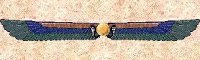
Winged Solar Disk
This is a form that the god
Horus Behudety (Horus of Edfu) takes in his
battles with
Seth. The god
Thoth used his magic to turn Horus into a sun-disk with splendid outstretched wings. The goddesses Nekhbet and Uazet in the form of
uraeus snakes joined him at his side.


